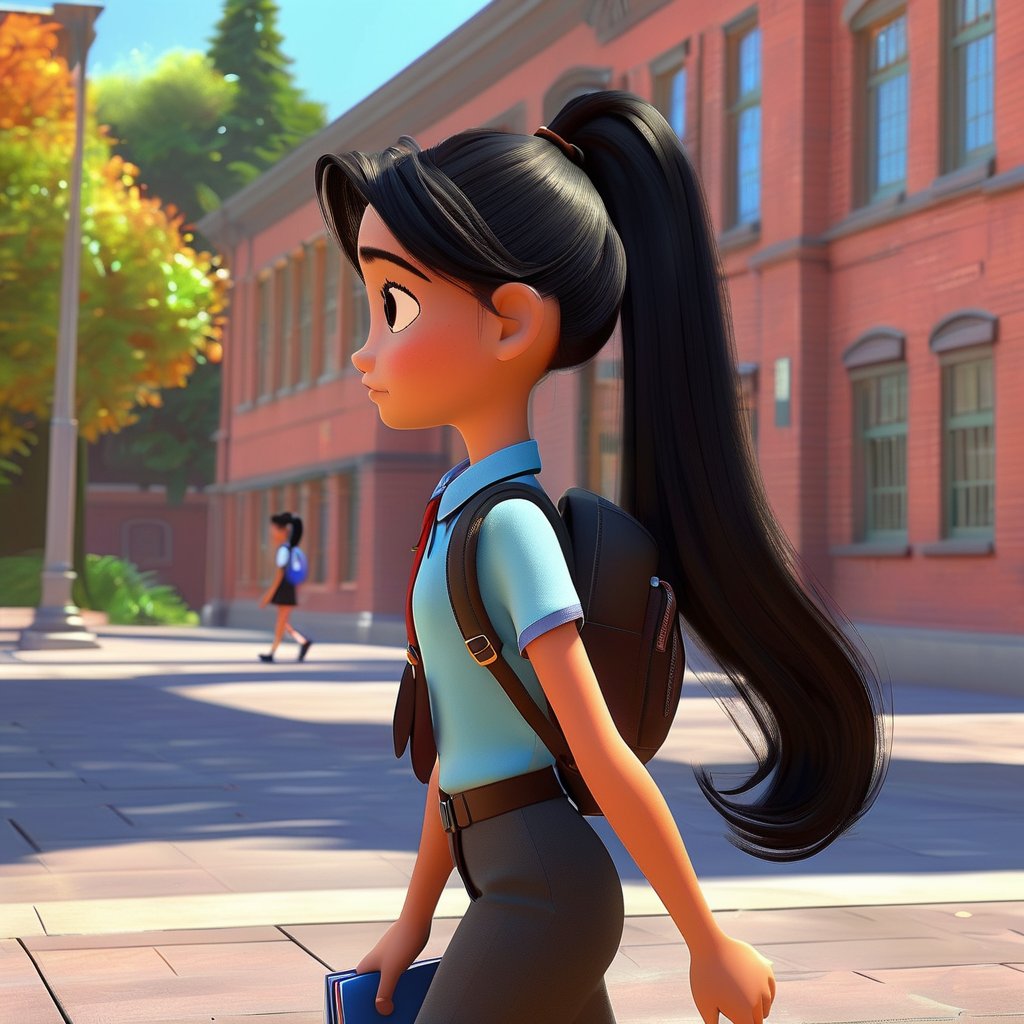
What if your favorite animated character stepped right out of their cartoon world and into ours, looking so real you’d swear they were standing beside you? This isn't a trick of the light or a futuristic dream; it’s the tangible reality of AI cartoon-to-real-life generators. These remarkable digital tools are fundamentally changing how we perceive and interact with visual media, allowing us to bridge the gap between imagination and photorealistic reality.
At a Glance: AI Cartoon-to-Real Generators
- What they are: Advanced AI tools that transform animated characters or drawings into photorealistic images or 3D models.
- How they work: Utilize machine learning, deep neural networks, Generative Adversarial Networks (GANs), and diffusion models trained on vast datasets of real-world visuals.
- The Process: Involves analyzing cartoon features, matching them to learned realistic patterns, and then synthesizing a new, lifelike image or model.
- Why they're popular: Offer accessibility, spark creative exploration, drive viral content, and provide powerful professional visualization tools.
- Key tools: Examples include Artbreeder, Fotor AI, Midjourney, Toongineer, Modelia, and specialized platforms like CGDream.
- Future outlook: Expect even greater realism, cross-medium transformations, emotionally intelligent rendering, and enhanced accessibility for storytellers.
From Sketch to Stunning: Unveiling AI Cartoon-to-Real Generators
Imagine taking a flat, two-dimensional drawing—perhaps a beloved cartoon character, a quick sketch, or even your own animated avatar—and watching an algorithm breathe photorealistic life into it. That's the core promise of AI cartoon-to-real-life generators. These aren't just simple filters; they're sophisticated digital sculptors, leveraging cutting-edge artificial intelligence to transform the fanciful into the familiar.
At its heart, this technology is about interpretation and recreation. It doesn't just "colorize" or "smooth" an image; it understands the underlying features of a cartoon—the distinct face structure, the exaggerated hair shape, the precise eye placement, the style of clothing—and then rebuilds them from the ground up using a library of learned real-world visual patterns. The result is a new version that maintains the original identity and expression, but now appears as if captured by a high-resolution camera.
The Deep Tech Canvas: How AI Translates Animation into Reality
The transformation from cartoon to real-life isn't a single, magic step. It’s a multi-stage computational dance involving deep learning and neural networks. Think of it as teaching an incredibly talented digital artist to interpret abstract drawings through the lens of reality.
When you feed a cartoon image into one of these generators, the AI embarks on a meticulous journey:
- Analysis: The first order of business is dissecting the input. The AI meticulously analyzes all discernible features: the contours of the face, the particular style of the hair, the exact position and shape of the eyes, the way clothing drapes (or doesn't). It’s looking for underlying geometric and stylistic information.
- Matching: Armed with this analysis, the AI then consults its vast internal knowledge base. This database consists of millions, if not billions, of real human faces, objects, environments, and textures it has "seen" and learned from during its training. It matches the cartoon's abstract features with realistic visual patterns—a cartoon eye becomes a real human eye with iris, pupil, and subtle reflections; a flat block of hair color becomes strands with natural highlights and shadows.
- Rendering: Finally, the AI synthesizes a brand-new image. This isn't an overlay; it's a completely generated output. This new image closely resembles a real-life photograph, yet it remarkably preserves the essence, identity, and expressive qualities of the original cartoon character. The character you know is still there, just in a different, more tangible form.
Unpacking the Magic: GANs, Diffusion Models, and the Detailed Process
Beneath these three high-level steps lies a world of complex algorithms, primarily driven by Generative Adversarial Networks (GANs) and, more recently, diffusion models. These are the engines that power the transformation.
Generative Adversarial Networks (GANs) at a Glance
Imagine two AI systems locked in a perpetual game of cat and mouse. One AI, the Generator, tries to create fake but realistic images from scratch. The other, the Discriminator, acts like a detective, trying to tell the difference between the Generator's fakes and real images it’s seen. Over countless rounds, the Generator gets better and better at fooling the Discriminator, and the Discriminator gets better at spotting fakes. This adversarial training pushes both to achieve incredibly realistic outputs. For cartoon-to-real, the Generator learns to create photorealistic versions from cartoon inputs, while the Discriminator ensures these outputs look genuinely "real."
Diffusion Models
Diffusion models work differently. They learn to systematically destroy training data by adding Gaussian noise and then reverse the process, "denoising" random noise to reconstruct desired data samples. For image generation, this means they can start from pure noise and gradually refine it, guided by a prompt (like "turn this cartoon character into a real person"), until a clear, high-quality image emerges. They are often praised for their high-quality and diverse outputs.
The Detailed Step-by-Step Breakdown
- Scanning & Recognition: The AI's initial interaction with your cartoon image is akin to a meticulous scan. It's not just seeing pixels; it's recognizing fundamental elements. It identifies skin tone, hair color, texture, and proportions. Crucially, it maps abstract shapes—like the stylized curve of a cartoon jawline or the exaggerated size of a character's eyes and mouth—to their real-world, anatomically plausible equivalents.
- Style Transfer: This is where the artistry really kicks in. Algorithms translate the flat, often simplified aesthetics of the cartoon into the rich, intricate textures of real life. For instance:
- Smooth, uniformly colored cartoon skin transitions into skin with natural pores, subtle blemishes, and varied tones.
- Bold, defining outlines become soft, subtle contours and shadows that suggest depth and form.
- Flat, blocky colors give way to realistic shading, gradients, and light reflections, mimicking how light interacts with real-world surfaces.
- Image Synthesis: Using the principles of GANs or diffusion models, a new image is synthesized from scratch. It’s not simply editing the existing cartoon; it's building a new photorealistic image that is guided by the cartoon's structure and identity. In a GAN, the generator component creates this new image, which is then refined iteratively as the discriminator assesses its realism.
- Post-processing: Once the core image is synthesized, a final layer of refinement is applied. This includes crucial steps like face alignment, ensuring features are proportionally correct and symmetrical; lighting correction, to create a consistent and natural light source; and detail enhancement using upscaling algorithms to achieve a crisp, high-resolution, true-to-life output. This stage ensures the generated image isn't just real, but photorealistic.
Why We're All Hooked: The Irresistible Appeal and Broad Applications
The surge in popularity of AI cartoon-to-real generators isn't just a fleeting trend; it's a testament to their utility, accessibility, and sheer creative potential.
Accessibility for Everyone
One of the biggest drivers of their widespread adoption is how incredibly user-friendly these tools have become. Many platforms offer intuitive interfaces where anyone, regardless of technical skill, can upload a cartoon image or enter a text prompt and receive a realistic conversion in moments. This democratizes a powerful technology, making it available to the masses. If you're looking to explore this world for yourself, many platforms offer a Free AI cartoon generator to get started with no strings attached.
The Viral Content Machine
These generators are tailor-made for the social media age. Creating realistic versions of beloved, iconic characters—think classic Disney princesses, popular anime heroes, or even quirky internet memes—is a surefire way to generate viral content. It taps into nostalgia, curiosity, and the sheer wow-factor of seeing the impossible made real.
Unleashing Creative Exploration
For artists and designers, these tools open up entirely new avenues for creativity. They allow for seamless style blending, letting artists experiment with different aesthetics. They serve as incredible aids for concept visualization, transforming early character sketches into tangible, realistic prototypes. Character designers can iterate rapidly, testing how their creations would look in a live-action context without having to redraw or resculpt everything from scratch.
Riding the Wave of Technological Advancement
The underlying AI models are constantly evolving. What was impressive last year is standard today. Continuous improvements in resolution, the accuracy of textures, the subtlety of facial expressions, and the ability to preserve a character's unique essence mean that outputs are becoming increasingly indistinguishable from real photographs.
Beyond Entertainment: Professional and Educational Horizons
While the fun factor is undeniable, the utility of AI cartoon-to-real generators extends far into professional and educational realms:
- Concept Artists can swiftly visualize how their animated character designs would appear in live-action adaptations, streamlining pre-production processes.
- Producers and Directors can test potential character looks for live-action reboots or CGI-heavy films, making informed decisions about casting and visual effects.
- Game Developers can create highly lifelike avatars, non-player characters (NPCs), or even visualize game assets with unprecedented realism, enriching immersive experiences.
- Educators can use these tools to demonstrate the differences between abstract art and realism, helping students grasp visual concepts.
- Personal Use isn't just about transforming existing characters; users can turn their own cartoon selfies or self-designed anime characters into photorealistic images for social media, personalized avatars, or simply for entertainment.
Inside the Studio: A Closer Look at Tools Like CGDream
While many general-purpose AI image generators can handle cartoon-to-real transformations, some platforms offer specialized tools designed for deeper control and more diverse output types. CGDream stands out by providing both "Cartoon to real life" image generation and powerful 3D model creation from photos or text.
Crafting 3D Models from Photos: CGDream's Approach
CGDream's 3D model generator from photos is a game-changer for anyone looking to translate 2D images into volumetric reality.
You upload an existing photograph, and the AI takes over, converting it into a 3D model or image. To get the best results, start with images that have good lighting, clearly defined shapes, and a simple background, ideally in JPG or PNG format.
The Process:
- Upload Your Image: Simply drag and drop your chosen photo.
- Choose Your Settings: Here's where you define the output. You'll select mesh type (e.g., Quad Mode for clean topology), material settings (PBR for realistic rendering, Shaded for simple colors), and your preferred export file format.
- Generate the Model: Hit "Generate." You can even use a "Dream-up" feature to get ideas if you're feeling uninspired.
- Wait and Preview: The AI analyzes the image's shape, structure, shading, and geometry, then transforms it. This process typically takes about 90 seconds.
- Download and Refine: Once generated, you can preview your 3D model and download it. If it’s not quite right, you can often refine settings and regenerate.
Customization for Control: CGDream offers extensive control over the output:
- Prompt Guidance: This slider dictates the AI's creativity. Higher values yield more detailed and defined models, adhering closely to the input. Lower values encourage more experimental, perhaps surprising, outcomes.
- Seed: A numerical value that generates variations of the same model. Changing the seed slightly can produce unique interpretations while keeping the core concept.
- Mesh Mode:
- Quad Mode: Ideal for animators and artists who need clean, organized mesh topology for rigging and further editing.
- Raw Mode: Provides faster, simpler, triangle-based meshes, suitable for quick previews or less demanding applications.
- Custom Polygon Count: Directly influences model complexity. A higher count provides more detail but results in larger file sizes and potentially longer generation times. A lower count is more efficient for real-time applications or quick drafts.
- Material Settings:
- PBR (Physically Based Rendering): Generates models with realistic lighting and material properties, essential for high-fidelity rendering.
- Shaded: Produces models with simple, flat colors, good for stylized looks or conceptual visualization.
- All: Combines elements for a balanced result.
- Export Format: A wide array of compatible formats ensures your model can be used across various 3D software and engines.
- Quality: Higher quality settings mean more intricate detail and realism, though generation might take slightly longer than the typical 90 seconds. Lower quality is excellent for rapid prototyping and experimentation.
Imagining 3D Worlds from Words: Text-to-3D with CGDream
What if you don't have a photo, but a clear vision? CGDream's text-to-3D generator allows you to create models purely from a written description.
The Process:
- Write Your Prompt: Describe your desired 3D model in detail. Short sentences work, but highly descriptive prompts (e.g., "A mouse that looks like a cat and has rabbit ears") yield more precise results. You can even add up to five "filters" to guide the style or characteristics.
- Set Prompt Guidance: Similar to the photo-to-3D tool, this controls the AI's adherence to your prompt versus its own creative interpretation.
- Choose Model Settings: Configure mesh type, material, polygon count, and export format, just as you would for photo-to-3D.
- Generate the Model: The AI analyzes your text for shape, structure, and style, then synthesizes the 3D model. This also takes around 90 seconds, possibly more for higher quality or complex details.
- Download and Refine: Preview, download, and iterate if necessary.
Customization: The customization options for text-to-3D are largely identical to the photo-to-3D generator, offering granular control over the final output, from mesh complexity to material realism.
Transforming Visuals: CGDream's Cartoon-to-Real Image Generation
Beyond 3D, CGDream also excels at generating "Cartoon to real life" images directly. This function leverages state-of-the-art text-to-image diffusion models, allowing for highly nuanced and detailed transformations.
The Process:
- Launch the Generator: Access the dedicated cartoon-to-real image tool.
- Detail Your Prompt: Clearly describe the desired realistic image based on your cartoon concept. The more specific, the better.
- Refine with Options: Choose a specific style (e.g., "photorealistic," "hyperrealistic"), apply filters, select the number of variations you want, and set the aspect ratio. You can even provide an optional guide image or 3D model to further influence the output.
- Generate in Seconds: Hit "Generate," and the AI will render stunning images in a matter of seconds.
- Edit or Download: You can use built-in editing tools for final tweaks or download your realistic image immediately.
Your Blueprint for Brilliance: Tips for Optimal AI Conversions
While these tools are incredibly smart, you can significantly enhance your results with a few insider tips:
- Start with Clarity: The AI is only as good as its input. Always begin with clear, high-resolution cartoon images. Blurry or pixelated sources will lead to less defined and potentially distorted real-life outputs.
- Control Realism Intensity: Many tools offer sliders or settings to control the "realism intensity." Experiment with these to manage exaggerated cartoon features. A high realism setting might make a character's unnaturally large eyes appear unsettling, while a lower setting could maintain some stylized charm.
- Aim for Consistent Lighting: For the most natural-looking realism, prefer cartoon images with consistent or neutral lighting and simple backgrounds. Complex, chaotic backgrounds can confuse the AI, leading to artifacts or less cohesive results.
- Refine with Photo-Editing Tools: AI generation is powerful, but it’s rarely perfect on the first try. Don't hesitate to use traditional photo-editing software (like Photoshop, GIMP, or even basic phone editors) to make minor adjustments to color, contrast, or small details in the AI-generated output.
- Respect Copyright: When transforming copyrighted characters (e.g., Disney, Marvel, anime), always ensure you have the necessary permissions if you plan to use the generated images for anything beyond personal enjoyment. Unauthorized commercial use can lead to legal issues.
The Powerhouses: Popular AI Cartoon-to-Real Generators at a Glance
The market for AI art tools is booming, with several contenders making waves in the cartoon-to-real space:
- Artbreeder: Known for its generative adversarial network capabilities, Artbreeder allows users to "breed" images, creating variations and blends that can be steered towards realism.
- Fotor AI Image Generator: A versatile online tool that includes functions for turning cartoons into realistic portraits, often praised for its ease of use.
- Midjourney: While more of a text-to-image generator, Midjourney can produce incredibly detailed and artistic photorealistic images from descriptive prompts, making it capable of interpreting cartoon concepts.
- Toongineer Cartoonizer (by DeepAI): Specifically designed for cartoonization and realistic conversion, offering straightforward functionality.
- Modelia: This platform, particularly with its sketch-to-image tool, is excellent for transforming line art and simple drawings into more refined, realistic images or models.
Each tool has its strengths, whether it's the depth of control, the artistic flair, or sheer accessibility. Exploring a few can help you find the best fit for your specific creative needs.
Looking Ahead: The Evolving Landscape of AI Transformation
The journey of AI cartoon-to-real generators is far from over. Expect rapid advancements that will push the boundaries of what's possible:
- More Precise Realism: Future models will achieve even finer details, capturing micro-expressions, subtle skin imperfections, and realistic reflections that enhance the illusion of life.
- Cross-Medium Transformation: Imagine effortlessly converting a 2D cartoon into a fully rigged 3D model ready for animation, or even transforming it directly into an augmented reality (AR) or virtual reality (VR) experience.
- Emotionally Intelligent Rendering: AI will likely become more adept at understanding and accurately translating complex emotions and nuanced personality traits from cartoon characters into their realistic counterparts, making them even more believable.
- Accessibility Integration: As the technology matures, expect seamless integration into existing creative software, educational platforms, and everyday apps, making advanced AI art generation as common as applying a photo filter. These tools will increasingly empower storytellers to visualize their narratives in new and compelling ways.
Navigating the Nuances: Common Questions & Ethical Considerations
Like any powerful technology, AI cartoon-to-real generators bring questions and considerations to the forefront.
Q: Is this technology only for professional artists?
A: Absolutely not! While professionals use it, many tools are designed for user-friendliness, making them accessible to hobbyists, educators, and anyone curious to experiment. Many platforms even offer a free AI cartoon generator for easy entry.
Q: Can these tools create "deepfakes" from cartoons?
A: In a sense, yes. The technology shares underlying principles with deepfake creation (generating realistic images based on source material). However, the primary intent of cartoon-to-real generators is creative transformation, not malicious impersonation. The ethical implications largely depend on how the technology is used.
Q: What about copyright and intellectual property?
A: This is a significant concern. While converting a copyrighted character for personal enjoyment is generally harmless, using AI-generated realistic versions of famous characters for commercial purposes without permission can lead to serious legal issues. Always be mindful of intellectual property rights, especially if you plan to share or monetize your creations.
Q: How accurate are the realistic conversions?
A: Accuracy varies widely by the tool and the complexity of the input. Modern AI is incredibly good at capturing facial structures and expressions. However, highly stylized or abstract cartoon characters might yield less "accurate" or sometimes uncanny results, as the AI struggles to find a realistic equivalent for features that defy real-world physics.
Ready to Transform? Your Next Steps in AI Generation
The world of AI cartoon-to-real-life generators is a thrilling frontier, merging imagination with cutting-edge technology. Whether you're an artist looking for a powerful new visualization tool, a content creator aiming for viral engagement, or simply someone fascinated by the potential of artificial intelligence, these generators offer an unparalleled opportunity to bring your animated visions into stunning, tangible reality.
Start by exploring some of the platforms mentioned, experimenting with different cartoon inputs, and playing with the customization options. You might be surprised at what you can create. The ability to transform characters, objects, and even entire worlds from the realm of the fantastical into the realm of the real is not just a technological marvel—it's an invitation to redefine the boundaries of creativity itself.